Underlying Program Goals:
// lead students in HANDS-ON construction combined with a design studio education in order to discover new intersections between design and fabrication.
// foster a COLLABORATIVE studio environment such that students engage more fully in a dialogue with their peers, practitioners, context and communities.
// implement architecture, design and the making of space to catalyze POSITIVE SOCIAL CHANGE and stewardship of our built environment.
February 11, 2009
February 8, 2009
Group_A 2/7 modeling photos
fiber artist
sat 020709 images
![]() |
| UdB 020709 |
images from yesterday's experiments. to recap the design initiative for wednesday: provide 4 vignettes at 8.5x11 showing your group's 4 structures -- canopy, thru-way, exhibiton, freeform -- populated with users, entourages, callouts (fill up the whole page!). feel free to think of these constructs at any scale, and use any preferred media technique (colored pencil, photoshop, magazine collage, etc.)
February 6, 2009
first set of experiments
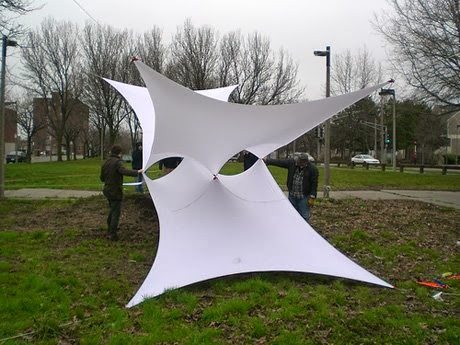
first set of tensile experiment using the all-thread frame. in the initial process, we are looking at free-form iterations; however, we will quickly need to develop a rigor for evaluating our studies by isolating variables.
to consider:
_saddle variants
_add'l exterior attachment points
_add'l interior attachment points
_internal ring (cone)
_apertures
see yall tomorrow. i can meet before 12 if anyone is interested // cg
to consider:
_saddle variants
_add'l exterior attachment points
_add'l interior attachment points
_internal ring (cone)
_apertures
see yall tomorrow. i can meet before 12 if anyone is interested // cg
![]() |
| UdB 020609 |
February 5, 2009
frozen form-making
http://picasaweb.google.com/charlesmgarcia/TRCPrototypesUmich06?authkey=8Zs_9p0oi6E&feat=directlink
here are a few images of fiber reinforced concrete experiments using a similar cube-frame strategy for generating the form. instead of spandex, we used a loose-weave mesh from jo-ann fabrics. after achieving the desired form, we painted the fabric with quik-crete and allowed to cure overnight. not incredibly clean results, but certainly a great way to maintain a form library for reference.
Subscribe to:
Posts (Atom)
Nomadic Canopies, mock-up session - Spring '09
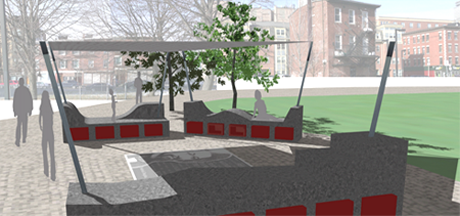
Frederick Douglass Peace Park Amphitheater, rendering - Spring'08